Heads up for utility customers:
The May 10, 2025 water and sewer bills went out Thursday, May 15. The delay is due to data conversion issues tied to the City’s utility billing system upgrade.
While the bills are still dated May 10, 2025, we have pushed the due date to June 6, 2025.
Thank you for your patience as we make improvements to better serve you.
2025 Water and Sewer rates:
Each year, the City reviews what it costs to provide clean water and sewer service to our community. These services are not paid for by property taxes—they're funded only by the people who use them.
Water and sewer charges help cover the cost of pumping, treating, and delivering water, as well as removing and treating wastewater. They also help pay for repairs and long-term improvements to the system so everything keeps running smoothly.
Last year, we anticipated raising rates by 10% for water and 5% for sewer starting May 1, 2025.
After a closer look, we were able to lower those increases. The new rates will go up by 7.5% for water and 2.5% for sewer. You’ll see these changes on your June bill, which covers May’s service.
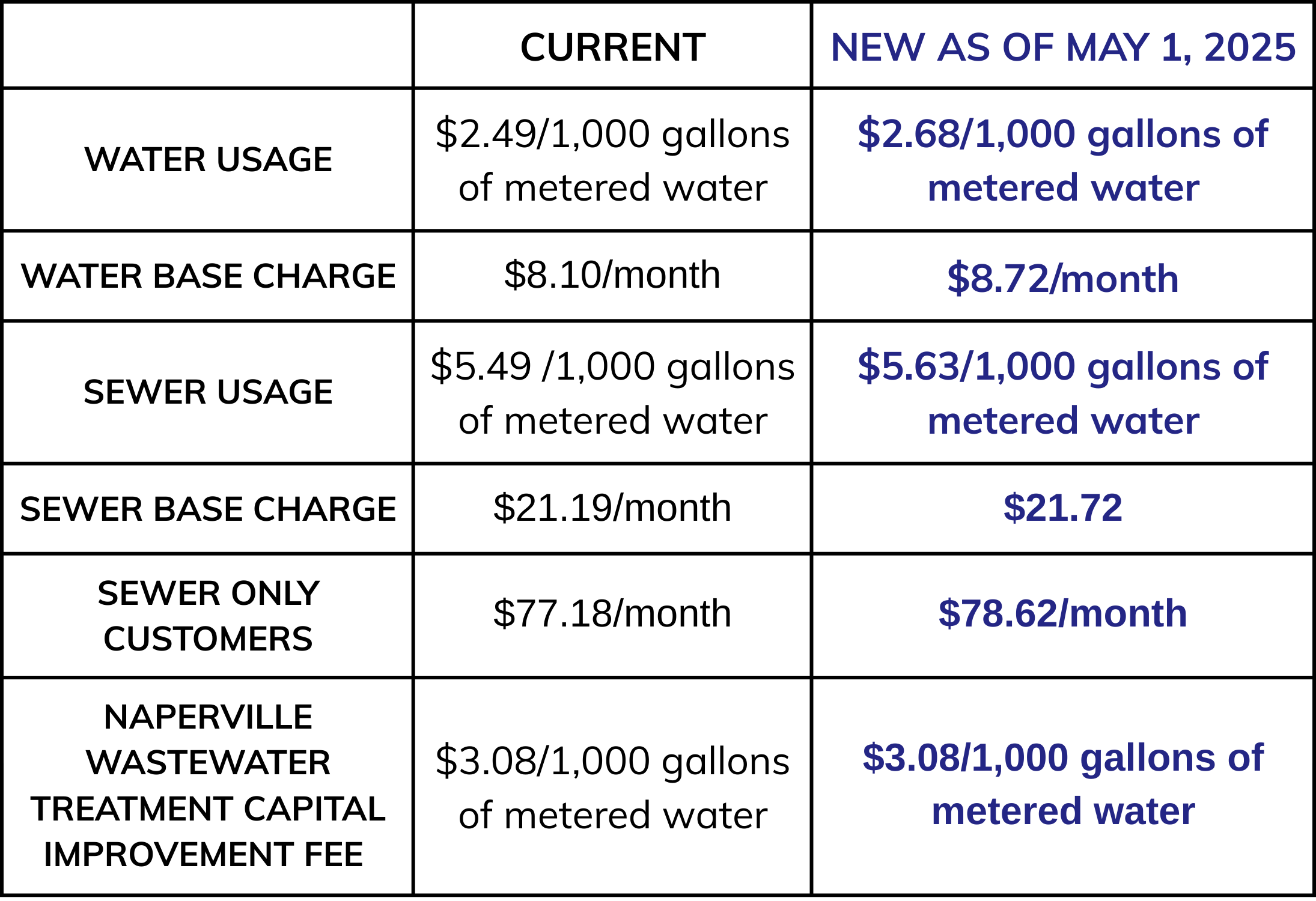
What is the Naperville Wastewater Treatment Capital Improvement Fee? All of the City's wastewater, by a long-standing agreement with the City of Naperville, goes to the Naperville system for required treatment.
Naperville's wastewater treatment plant needs major upgrades. Some of the equipment is 50 years old, and the plant must also be brought up to Illinois Environmental Protection Agency (IEPA) standards.
The City will contribute 9% of the total cost of this project. This is based on the fact that Warrenville produces approximately 9% of the flow that goes into Naperville's system.
Total cost estimates are $170 million for the project, with Warrenville's share approximately $22 million, including estimated financing and interest. The City will structure this payment over several years.
For more details, read the Water Treatment Plant FAQ below:
Why does Naperville need to upgrade its facility?
There are multiple reasons. Some upgrades include replacing equipment that is 50 years old. Other upgrades address Illinois Environmental Protection Agency (IEPA) requirements to reduce the amount of phosphorous in the effluent released from the treatment plant.
The project will also expand the plant’s capacity for biological treatment of the solids in the water.
Why doesn’t Warrenville build its own treatment plant now?
The are several reasons, including it is more cost-effective to pay Naperville to treat Warrenville’s flows and occasionally pay Naperville for Warrenville’s proportional share of any maintenance and replacement or upgrade costs to the treatment plant.
- Warrenville’s flows enter Naperville’s system at two locations. It is unlikely that Warrenville could find a location in the community that could treat all of Warrenville’s flows without some major work to reroute the flows from one or both of those parts of the system to wherever the plant would be constructed. Without knowing where the plant would be, it is impossible to estimate the scope or cost of the improvements necessary to reroute the flows. The costs would be in the millions of dollars.
- Constructing a new plant to treat Warrenville’s wastewater to today’s standards is estimated to cost $65 million.
- Warrenville would also need to staff the plant, which means an estimated additional 3-4 fulltime staff, at an estimated cost of $325,000 to $415,000 of salaries and benefits per year forever.
Could Warrenville send its flows to another neighboring community (Aurora, West Chicago, Wheaton)?
No. Those plants are not sized to accommodate Warrenville’s flows. Even if it was possible, those plants would need to be expanded, if they even could be, and Warrenville would have to pay for those expansion costs, which would likely be significantly more expensive than paying Naperville.
Additionally, Warrenville’s sanitary sewer system flows primarily by gravity, and drains toward Naperville, at the south City limits. Even if it were possible to replace the miles of sanitary sewer necessary to make it flow a different direction, those costs plus the necessary new or upgraded pipes to convey the flows through the other municipality to their treatment plan would be cost-prohibitive. Especially when added to the already cost-prohibitive treatment plant upgrades.